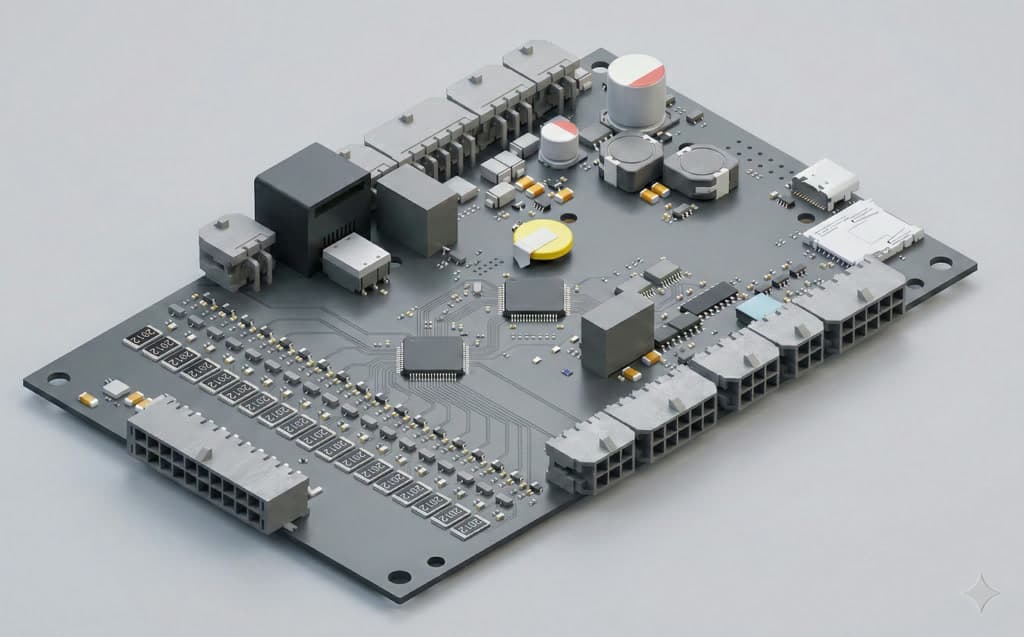
Cell balancing is one of the most misunderstood BMS features. Many engineers treat it as a checkbox: the BMS either has balancing or it doesn't. But the balancing current rating is one of the most consequential specifications on the datasheet, and the difference between 200mA and 1000mA can mean the difference between a pack that ages gracefully and one that loses usable capacity within its first year [1].
What Passive Balancing Actually Does
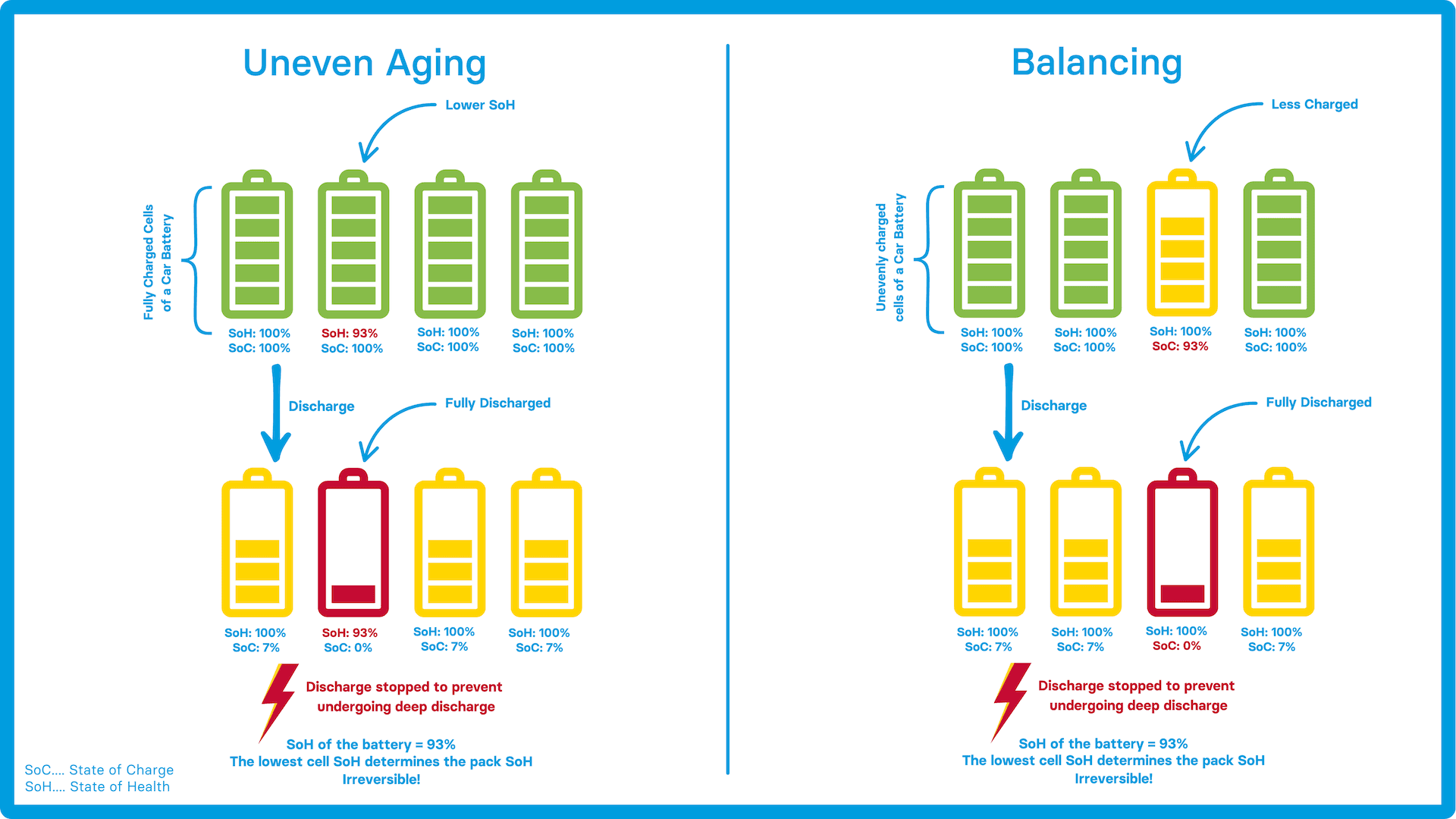
Every lithium cell in a pack has slightly different capacity, internal resistance, and self-discharge rate, even cells from the same manufacturing batch. Over hundreds of charge-discharge cycles, these differences cause cells to drift apart. Some reach full charge before others. Some deplete faster. Without balancing, the weakest cell limits the entire pack's usable capacity, because the BMS has to stop discharging when the lowest cell hits its cutoff voltage regardless of what the other cells still have in reserve [2].
Passive balancing addresses this by bleeding excess energy from higher-voltage cells through resistors during the constant-voltage charging phase. The energy is dissipated as heat. It's not elegant, but it's reliable, simple to implement, and effective, provided the balancing current is high enough to actually make a difference.
At 200mA balancing current, equalizing a 50mAh imbalance across 18 cells takes over 4 hours. At 1000mA, the same equalization completes in under an hour. That difference matters enormously for energy storage systems that need to cycle daily.
The Math, Made Practical
Take a real scenario. An 18-cell NMC pack with 100Ah cells has been in service for two years. Normal aging has created a 50mAh capacity spread between the strongest and weakest cells. That's only 0.05% of cell capacity. Sounds trivial. But it's enough to reduce usable pack capacity by several percent, because charging and discharging always stop at the weakest cell's limits.
With 200mA balancing current (common in entry-level BMS), equalizing that 50mAh difference takes over 4 hours when you account for multiple cells needing different amounts of correction. For a residential energy storage system charging from solar during a 6-hour window, the pack spends most of its charge time balancing rather than absorbing useful energy.
At 420mA (as in the LiBat BMS1810), equalization drops to roughly 2 hours [3]. At 1000mA (as in the BMS1802 slave module built for ESS applications), it completes in under an hour, leaving the rest of the charge window available for actual energy storage. That's not just faster. It's the difference between a system that works and one that underperforms.
Heat Is the Price You Pay
Higher balancing current means more heat dissipation. At 1000mA through a balancing resistor with a 4.2V cell, each balancing circuit dissipates about 4.2 watts. Across 18 cells balancing simultaneously, that's 75 watts of heat inside the BMS module. Not trivial [4].
This is where thermal design separates serious BMS products from the rest. The BMS1802 handles it with integrated heat sink provisions and separate temperature monitoring on the balancing circuits. Internal NTC sensors track board temperature independently of cell temperature. The firmware throttles balancing current if thermal limits are approached, creating a closed-loop system that always operates at the maximum safe rate rather than being permanently derated to some conservative fixed value.
We've seen competitive products that spec 1000mA balancing but thermally derate to 300mA within minutes of activation because the board layout can't dissipate the heat. The datasheet number means nothing without the thermal design to sustain it.
Matching Balancing Current to Your Application
The right balancing current depends on your duty cycle.
For micro-mobility (e-scooters, e-bikes) where packs are swapped and charged overnight with plenty of time, 200 to 400mA is usually sufficient. Cells are small (10 to 30Ah), imbalances accumulate slowly, and charge windows are long relative to the equalization needed.
For energy storage systems with daily cycling, 400mA is the minimum that works in practice, and 1000mA is strongly preferred. ESS cells are large (50 to 280Ah), charge windows may be constrained by solar generation hours or time-of-use electricity tariffs, and every percent of lost usable capacity translates directly to lost revenue [5].
For high-voltage systems using daisy-chain slave modules, each slave's balancing operates independently. The BMS1802's 1000mA capability was chosen specifically for ESS applications where every minute of balancing time counts [6].
The Takeaway
When you're evaluating a BMS, look past the checkbox. Ask how many milliamps. Calculate how long equalization takes relative to your charge window. Consider whether the thermal design can sustain the rated balancing current or whether it's a peak-only specification. The balancing current you specify today determines the pack capacity your customers will still have two years from now [7].
References
- [1]Andrea Bonfiglio et al., A Comprehensive Review of Battery Cell Balancing Strategies, IEEE Access, Vol. 11, 2023
- [2]IEC 62619:2022 — Secondary lithium cells and batteries for use in industrial applications — Safety requirements
- [3]LiBat — Battery Management Systems: BMS1810, BMS1802, and Complete Product Lineup
- [4]Xing et al., Thermal Management of Lithium-Ion Battery Pack: A Critical Review, Energy Conversion and Management, Vol. 276, 2023
- [5]BloombergNEF, Energy Storage System Costs Survey 2024 — LFP dominance in stationary storage applications
- [6]LiBat — Master-Slave BMS Architecture: From 48V to 900V Energy Storage
- [7]Diao et al., Active and Passive Battery Balancing Comparison Based on MATLAB Simulation, IEEE PES General Meeting, 2019