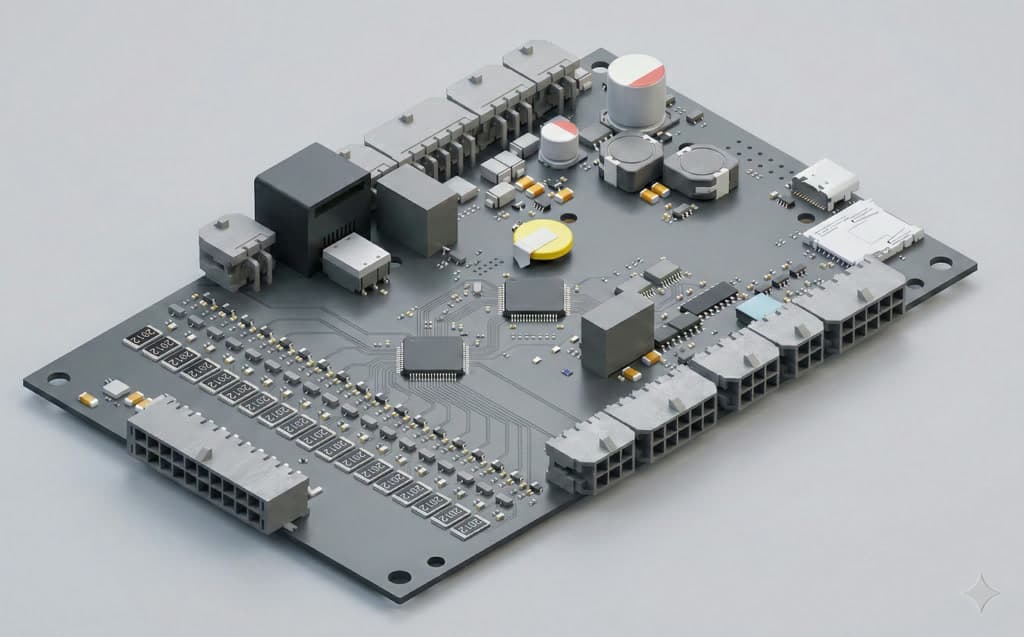

BMS3610
36S BMS MasterThe BMS3610 is a fully digital master BMS engineered for demanding industrial 5S to 36S battery systems. It drives distributed master-slave architectures with both BMS1802 and BMS1202 slave modules and scales to as many as 16 modules over galvanically isolated CAN Bus, RS485, and I/O. It can run from a 12V supply or directly from the battery, adds four automotive-grade high-side switches and a relay output, and uses robust, industrial-grade external connections for harsh operating environments.
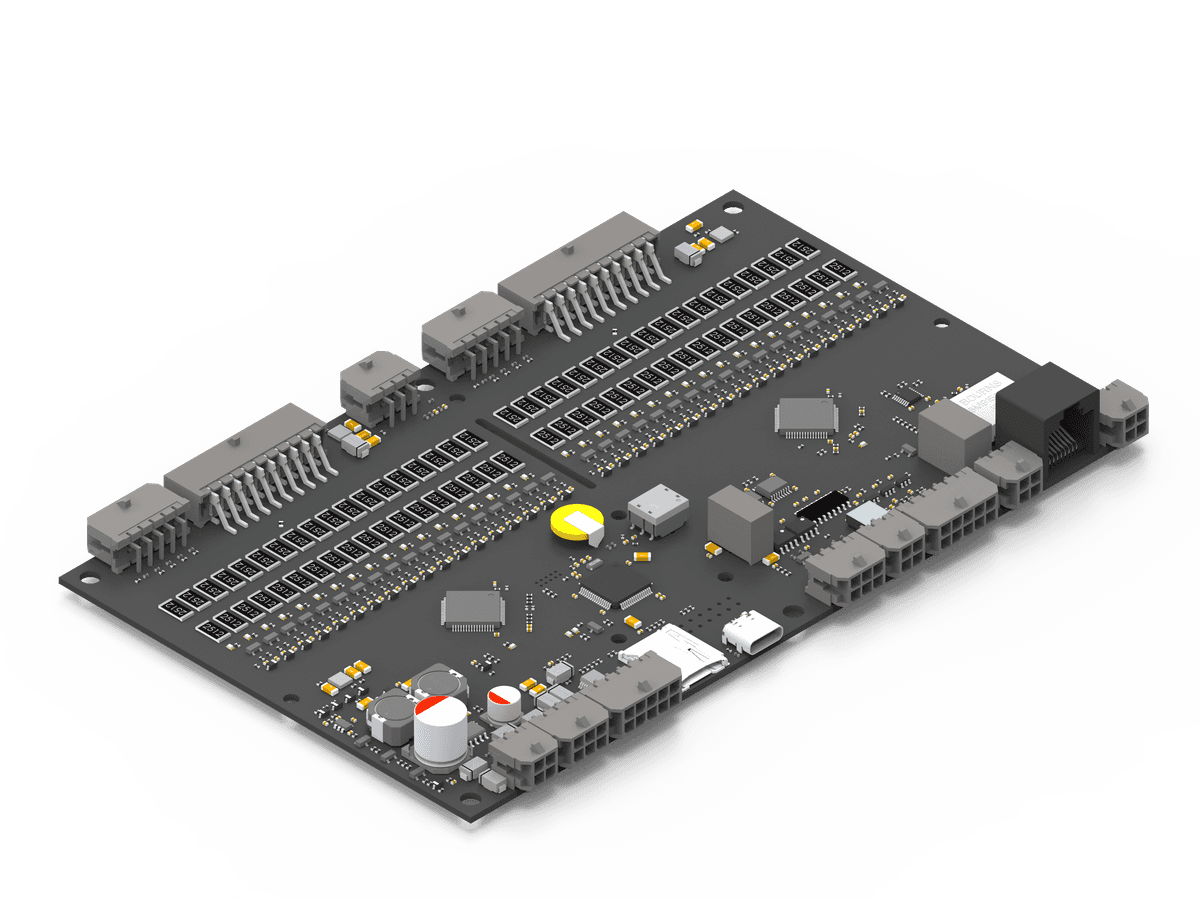
Overview
The BMS3610 is an advanced master built for the most demanding industrial battery systems. It manages 5S to 36S packs and expands through up to 16 slave modules, working with both BMS1802 and BMS1202 slaves to scale capacity to the application. Galvanically isolated CAN Bus, RS485, and I/O keep it reliable in electrically noisy environments, while flexible 12V or battery-powered operation suits a wide range of topologies. Four automotive high-side switches, a relay output, and ruggedized external connections make it dependable in the harshest conditions.
Highlighted Features
- 01
Flexible Cell Support
Monitors and protects from 5 to 36 cells, depending on cell chemistry.
- 02
Current Limit
Depends on external sensor specification. Any current level can be calibrated, which aligns with 0 to 5V sensor output.
- 03
Current Measurement Mode
Two channel measurement can be set for High and Low current channels, or independent current sensor channels.
- 04
Shutdown or Run Mode
Device runs in full power mode when powered up, but a shutdown mode can be triggered anytime by parameters or user button action. In shutdown mode, all components are powered down, including the input DC-DC, for minimum power consumption.
- 05
Wake-Up
User button input always wakes the device up from shutdown mode.
- 06
Onboard Power Supply
Any power source can be applied as power supply between 12V and 80V. Depending on cell chemistry, the device can directly power up from the battery output.
- 07
Parallel or Series Modes
Standalone master, master-slave, and multi-master modes can be set via the configuration tool for various battery pack architectures.
- 08
Balancing
Balance progress parameters can be set via the configuration tool. Balancing start-stop values, delta values, balancing start status, balance ratio, and the maximum number of balancing cells can be configured for application needs.
- 09
Flexible Inputs and Outputs
Any I/O function can be assigned to any available input or output for maximum flexibility.
- 10
Pre-Charge
Precharge events can be observed and their parameters set via the configuration tool. Precharge can be disabled, or activated in time-only or time/current mode, to meet the maximum flexibility of the battery pack. Any output can be assigned for precharge functionality.
- 11
Display
Any CAN Bus compatible display option can be used for detailed monitoring.
- 12
Remote Monitoring
A GSM and GPS based optional extension board can be used as an add-on. After connecting the extension, a simple firmware upgrade is needed to start remote monitoring of the system via the GSM line.
- 13
Bluetooth and Wireless
You have options for Bluetooth monitoring via a mobile application, or wireless monitoring via a browser on the local network. An external wireless-compatible display option or wireless module device needs to be connected via the CAN Bus line.
- 14
Flexible Digital Charger Integration
Digital charger integration can be configured for various charging scenarios: start-stop charging at a certain level, setting power paths according to the charger connection, preventing driving while charging, and more.
- 15
Charging Curve
Up to 30 charging current points can be defined for a more efficient charging profile suited to any type of battery pack. Current points based on SOC and temperature set the current level when a digital charger is connected to the CAN Bus line.
Basics
Cell Balancing
Temperature Monitoring
Isolated Communication
I/O & Control
Additional Features
Protection Functions
Board Dimensions
Mounting & Connectors
Environment
Ordering Information
Order codes and the options each one includes
| Order Code | Description |
|---|---|
| BMS3610 | Standard 36S unit without enclosure. No SD card, no USB functionality. |
Every order code ships with its mating connectors, pre-crimped cables and temperature sensors. They arrive unassembled so they can be fitted to the application.
Planning a project with the BMS3610?
Send us your cell count, chemistry and current range. Our engineers will reply with a configuration and a quote.