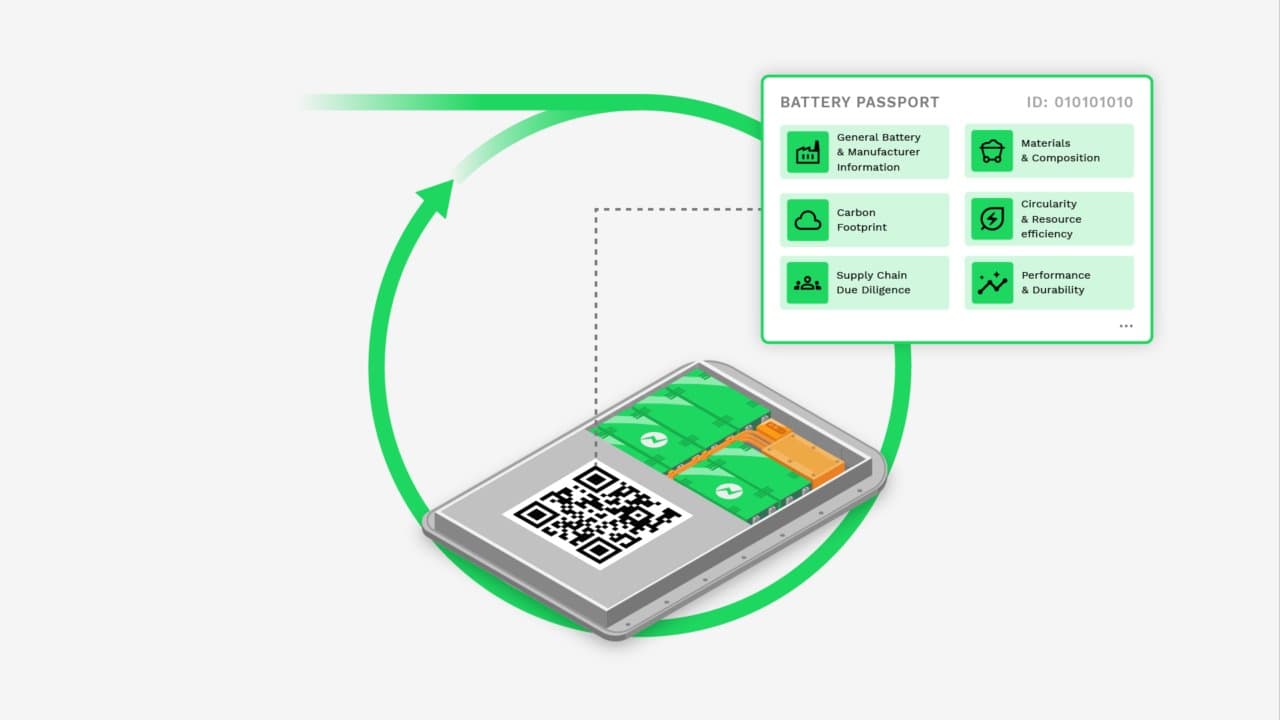
Starting February 18, 2027, every electric vehicle battery, every industrial battery above 2 kWh, and every light means of transport battery placed on the EU market must carry a digital battery passport [1]. A QR code on the pack links to a unique record containing manufacturing data, chemistry composition, performance ratings, lifecycle history, and recycling information. This isn't a voluntary standard or an industry initiative. It's EU Regulation 2023/1542, and non-compliance means your product cannot be sold in Europe.
The timeline is already moving. Carbon footprint declarations for EV batteries became mandatory in February 2025 [2]. Battery passports follow in 2027. Due diligence and recycled content requirements phase in through 2031. If you're manufacturing batteries or battery-powered equipment for the European market, preparation needed to start yesterday.
What the Passport Actually Requires
The regulation specifies several categories of mandatory data. Some come from manufacturing: chemistry, material composition, cell supplier, production date, rated capacity and energy, expected cycle life and calendar life, carbon footprint of production.
But a significant portion comes from the battery's operational life, and that's where the BMS becomes essential [3]. The passport must include:
- State of health tracked continuously over the battery's lifetime
- Charge-discharge cycle counts with timestamps
- Operating temperature history including thermal events and exceedances
- Capacity degradation trends showing actual vs. rated performance
- Fault events and protection activations with diagnostic context
- Energy throughput covering total kWh charged and discharged
This isn't data you can reconstruct after the fact. It has to be collected continuously from the moment the battery enters service.
The EU regulation explicitly requires dynamic data from the battery management system as part of the digital passport, making BMS connectivity a legal requirement for market access, not just a technical preference.
The BMS as the Compliance Engine
Here's what many companies overlook: a modern BMS already measures and processes almost everything the passport demands. Cell voltages, temperatures, current flows, charge cycles, SOH estimates, thermal events, and fault logs. The BMS tracks all of this in real time for its own protection and balancing functions.
The problem isn't data collection. It's data persistence.
A traditional BMS uses measurement data for immediate decisions (cell 7 is above 3.65V, stop charging) and then moves on. There's no historical record, no centralized storage, no way to retrieve two years of lifecycle data when someone scans the passport QR code. The BMS did its job, but the evidence is gone.
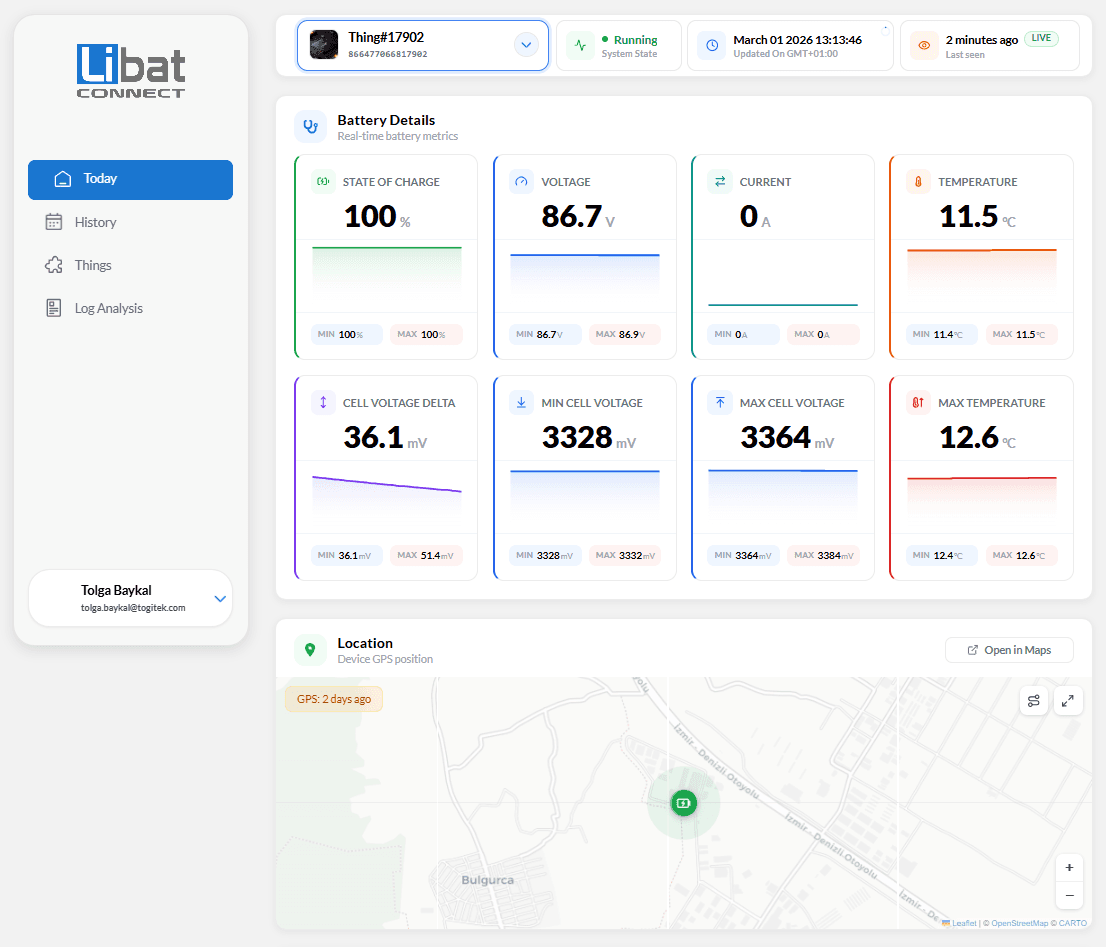
This is the gap that cloud-connected BMS closes [4]. When telemetry flows continuously to a cloud platform, every measurement gets stored, timestamped, and linked to a specific battery serial number. Generating a battery passport from this data becomes a formatting and reporting exercise: pulling the right fields into the right template. Without cloud connectivity, it becomes a manual record-keeping process that most operations teams simply won't sustain over a battery's full lifecycle.
State of Health: The Most Complex Passport Requirement
Among all passport data fields, state of health is the most technically demanding. The regulation requires SOH to be reported as a percentage of original rated capacity, updated continuously throughout the battery's service life [5].
Calculating SOH accurately requires multiple inputs working together: coulomb counting for charge throughput tracking, voltage-based capacity estimation during rest periods, internal resistance measurement through current pulse analysis, and temperature compensation across all calculations. No single method is sufficient on its own. Production BMS implementations combine these approaches and calibrate against field data to improve accuracy over time.
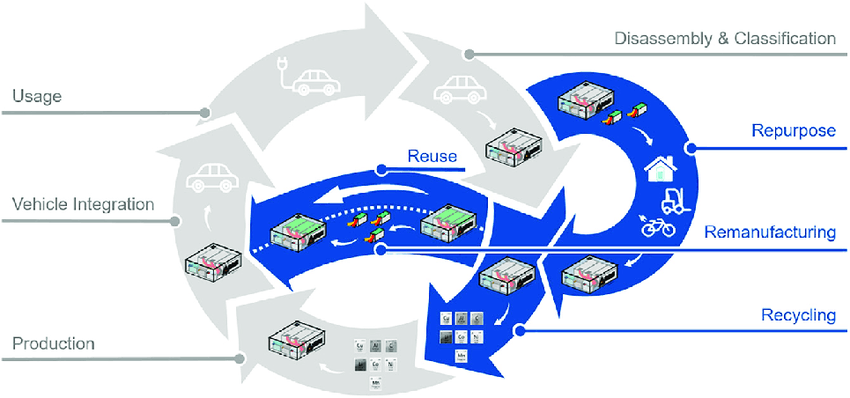
The challenge intensifies for batteries that change hands. A second-life battery moving from an EV to stationary storage must carry its full SOH history with it. The passport becomes the authoritative record of battery health, and the BMS is the only system capable of generating that record with the required granularity.
Carbon Footprint and Lifecycle Accounting
The regulation goes beyond the passport itself. Manufacturers must declare the carbon footprint of battery production using EU-specified methodology, and carbon offsets cannot be used to reduce the reported number [6]. Over time, batteries will be sorted into performance classes based on carbon intensity, giving buyers a clear environmental quality signal.
For cloud-connected batteries, there's an additional dimension. Operational energy efficiency data (charge-discharge losses, thermal management overhead, self-discharge rates) feeds into lifecycle carbon accounting. A cloud platform can calculate these metrics automatically and continuously, rather than relying on annual estimates.
Data Architecture for Passport Compliance
Building passport-ready infrastructure requires architectural decisions at every layer of the BMS stack [7].
On the BMS firmware side, the system needs unique battery identifiers embedded at production, persistent event logging that survives power cycles, and standardized data formats that downstream systems can parse without custom translation layers.
In the communication layer, telemetry must flow reliably from BMS to cloud with guaranteed delivery. Gaps in the data record undermine the passport's credibility and may constitute non-compliance.
At the cloud level, time-series storage must handle the volume (thousands of measurements per battery per day, across potentially thousands of batteries) while maintaining per-battery traceability and regulatory-grade data integrity.
We have begun developing the data architecture within our BMS platform to support passport-ready data collection and export [8]. This work spans persistent storage schemas on the firmware side, standardized telemetry formats in the cloud layer, and API design for regulatory reporting. The effort is ongoing, and we are working toward delivering passport-capable infrastructure ahead of the February 2027 deadline.
Preparing for 2027
Industry analysts estimate 12 to 18 months of preparation to build the data infrastructure for passport compliance. February 2027 is closer than it looks.
Collect data now. Every month of historical BMS telemetry makes future passport generation easier and more complete. Even if your passport format isn't finalized, raw data storage is cheap, and retroactive collection is impossible.
Choose BMS with native cloud connectivity. Retrofitting connectivity onto an existing BMS is expensive and fragile. If you're specifying BMS for new products today, cloud connectivity should be a procurement requirement, not a nice-to-have.
Standardize data formats early. Unique battery identifiers, consistent measurement units, secure transmission protocols. Getting these right at the beginning avoids painful migration later.
Work with vendors who understand the regulation. Passport compliance isn't a firmware checkbox. It requires architectural decisions at every layer, from how data is stored on the BMS through how it's served via API when someone scans the QR code.
Think beyond minimum compliance. The battery passport is the EU's first Digital Product Passport. Textiles, electronics, and construction materials will follow the same framework [9]. Companies that solve battery traceability now will have a reusable blueprint for every other product category the regulation expands into.
References
- [1]Regulation (EU) 2023/1542 — Concerning Batteries and Waste Batteries, Digital Battery Passport Requirements
- [2]European Commission — Carbon Footprint Rules for Industrial and EV Batteries, Delegated Regulation 2024
- [3]Battery Pass Consortium — Content Guidance for the Implementation of the Battery Passport
- [4]LiBat — Battery Management Systems: Complete Product Lineup and Communication Interfaces
- [5]Plett, G. L., Battery Management Systems, Volume I: Battery Modeling — SOH Estimation Methods, Artech House, 2015
- [6]European Commission Joint Research Centre — Rules for Calculating the Carbon Footprint of Batteries
- [7]Global Battery Alliance — Battery Passport Framework and Technical Standards
- [8]LiBat — Battery Passport: EU Compliance Module and Lifecycle Analytics
- [9]European Commission — Ecodesign for Sustainable Products Regulation (ESPR), Digital Product Passport