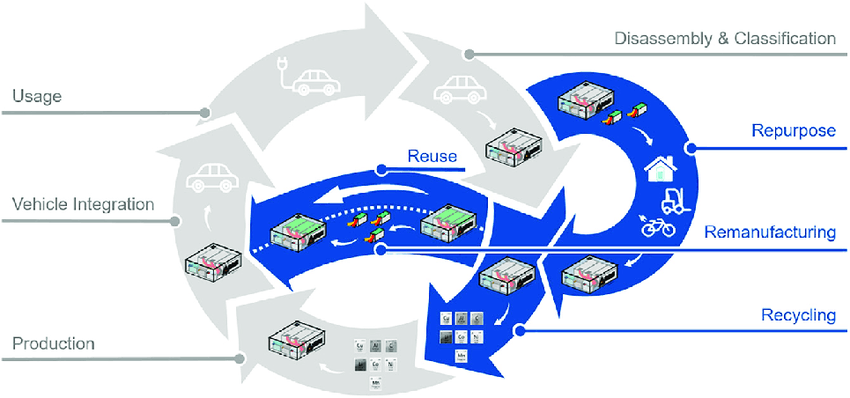

"Battery digitalization" gets thrown around a lot, and it means different things to different companies. For some, it means adding Bluetooth so a phone app can show cell voltages. For others, it means a cloud dashboard with fleet statistics. In our experience, most battery systems are assembled from components made by different vendors: one does BMS hardware, another writes firmware, a third provides monitoring tools, and a generic IoT service handles the cloud layer [1]. Each piece might work fine alone, but integration becomes a persistent engineering burden. Data formats don't align. Firmware updates require physical access. And when something goes wrong, three vendors point at each other.
We took a different approach: build every layer ourselves, so the data flows cleanly from cell to cloud without translation gaps or integration seams. Here's what that actually looks like.
Layer 1: Analog Measurement
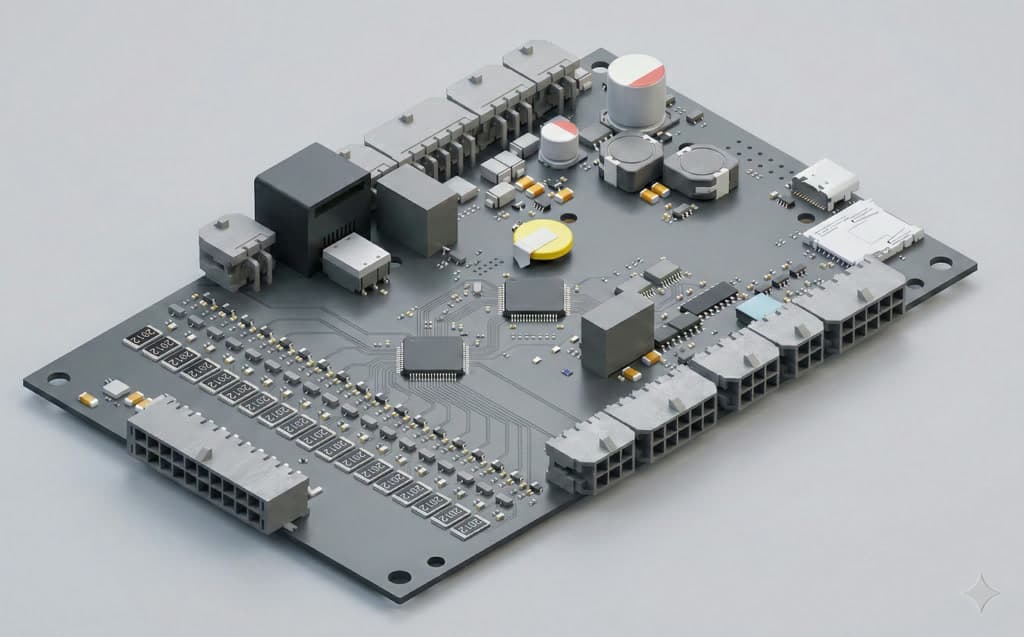
Everything starts at the cell. A dedicated analog front-end IC measures voltage across each cell in the series string [2]. This isn't a general-purpose ADC. It's a measurement system designed specifically for series-connected lithium cells, handling high common-mode voltage rejection, temperature compensation, and filtering for the electromagnetic interference that power electronics generate nearby.
Simultaneously, NTC thermistors measure temperature at multiple points: cell surfaces, bus bars, MOSFET junctions, and ambient locations. The BMS1810, for instance, reads 5 temperature sensors [3], enough to build a thermal map of the pack that reveals hotspots, cooling imbalances, and environmental stress that a single ambient sensor would miss entirely.
Layer 2: Embedded Firmware
Raw measurements don't mean much without processing. The firmware running on the BMS microcontroller transforms analog readings into useful information. Protection algorithms compare every measurement against configurable thresholds (overvoltage, undervoltage, overcurrent, overtemperature, short circuit) and can disconnect the pack within milliseconds through hardware-controlled MOSFET gates [4].
Beyond protection, the firmware calculates derived metrics. State of Charge combines coulomb counting with voltage-based estimation and temperature compensation. State of Health tracks capacity fade and internal resistance growth over the pack's lifetime. These calculations run continuously, updating multiple times per second, and they're updateable over the air as our algorithms improve with field data.
Layer 3: Communication and Desktop Tools
The BMS has to speak the language of whatever system it lives in. For vehicles and mobile machinery, that's CAN Bus. For building automation and energy storage, RS485 Modbus. For diagnostics and configuration, RS232 serial [5]. Our BMS masters support all three simultaneously on dedicated hardware interfaces, so a vehicle can receive real-time CAN data while a technician runs diagnostics over serial without any conflict.
On the desktop side, LiMon is our PC-based tool for configuration, diagnostics, data logging, and production testing [6]. Engineers use it during development; field technicians use it for troubleshooting. It's the same tool for every BMS model in the product line, which means one training session covers everything from a single-module pack to a high-voltage multi-rack installation.
For cloud connectivity, the BMS sends structured JSON data through a cellular or WiFi gateway to LiBat Connect, extending the digital thread from the physical battery to the internet. That's where things get interesting.
Layer 4: Cloud Platform
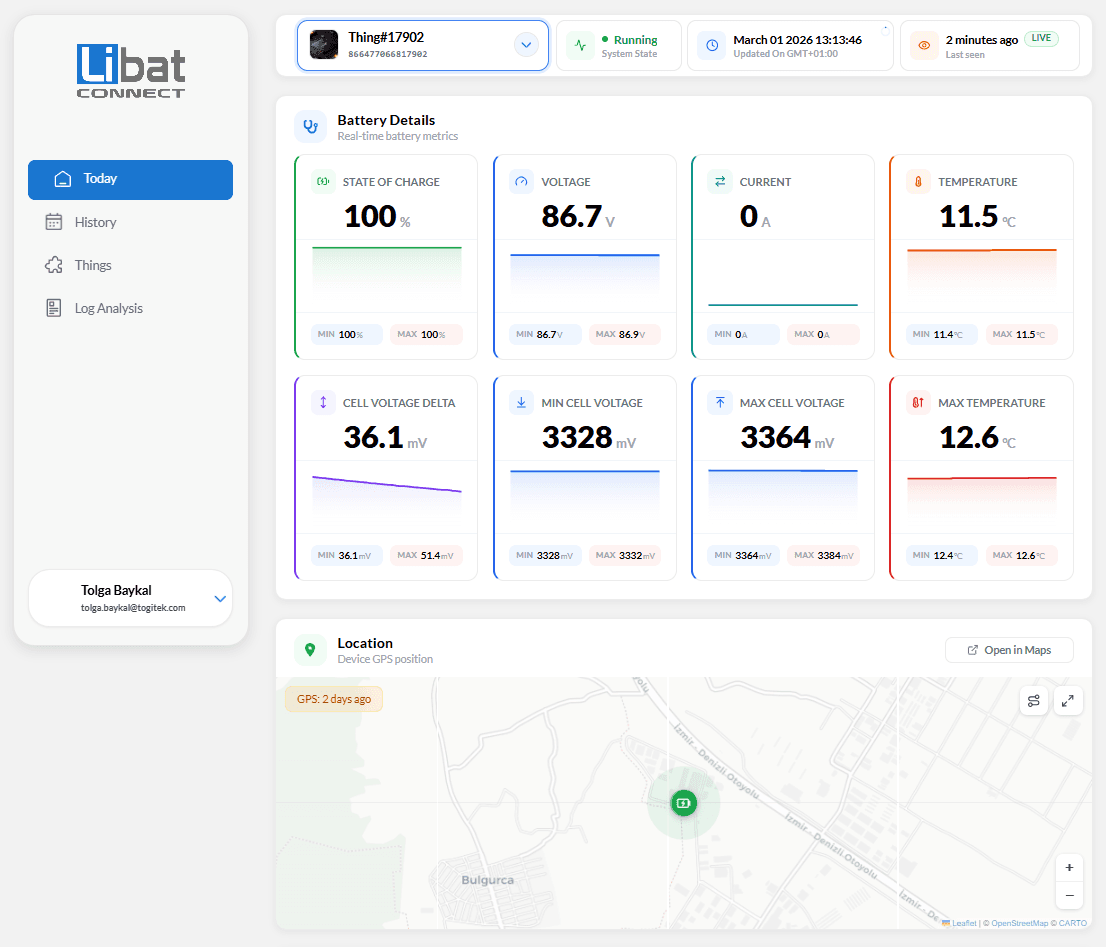
LiBat Connect receives, stores, and processes telemetry from BMS units across installations and geographies [7]. Every cell voltage, every temperature reading, every charge cycle, every protection event gets timestamped and stored in a structured time-series database.
At fleet level, the platform enables comparisons that a single BMS can never make on its own. Which battery racks are degrading faster than expected? Which vehicles consistently run at higher temperatures? Which installation sites show unusual cell imbalance patterns? These questions require data from hundreds or thousands of packs, exactly what a cloud platform aggregates.
The platform also manages firmware distribution. A protection threshold adjustment, an improved SOC algorithm, or a new communication feature can be pushed to BMS units in the field through over-the-air updates [8]. No truck rolls. No laptop cables. No scheduling headaches.
Layer 5: Actionable Intelligence
The point of all this isn't data collection, it's decision support. A battery rack showing accelerating capacity fade triggers a maintenance alert with specific recommended actions. A fleet-wide trend toward higher operating temperatures prompts a cooling system review. An approaching EU Battery Passport deadline (February 2027, under Regulation 2023/1542) generates a compliance readiness report based on data that's already being collected [9].
The intelligence layer is where cloud-connected BMS earns its keep. Raw telemetry is cheap to collect but useless without the analytics that turn numbers into recommendations an operations team can act on.
Why Vertical Integration Wins
When all five layers come from a single engineering team, data flows from cell to cloud without format conversion or protocol translation [10]. When a customer reports an issue, there's one team to call, not three vendors with three support queues. And time-to-market for pack manufacturers accelerates significantly: an integrated ecosystem skips months of integration work and delivers a production-ready monitoring solution from day one.
The journey we see most often: a customer evaluates a BMS module on the bench using LiMon, integrates it into a prototype pack, then connects to LiBat Connect for field monitoring. As production scales from 10 packs to 100 to 1,000, the same ecosystem handles the growth. No architecture changes, no platform migrations, no re-integration.
That continuity, from first prototype to fleet-scale deployment on the same platform, is what end-to-end actually means.
References
- [1]McKinsey & Company, Battery 2030: Resilient, Sustainable, and Circular — The Battery Value Chain
- [2]Plett, G. L., Battery Management Systems, Volume I: Battery Modeling, Artech House, 2015
- [3]LiBat — Battery Management Systems: BMS1810, BMS1601, and Complete Product Lineup
- [4]IEC 62619:2022 — Secondary lithium cells and batteries for use in industrial applications — Safety requirements
- [5]Reindl, A. et al., A Review of CAN Bus Protocol for Battery Management Systems in Electric Vehicles, IEEE Access, 2020
- [6]LiBat — Configuration Tools: LiMon PC Tool, LiMon CONNECT, and LiBat CONNECT Mobile
- [7]Frost & Sullivan, Cloud-Based Battery Management: Market Trends and Growth Opportunities, 2024
- [8]Bansal, P., OTA Updates in Automotive: Challenges and Best Practices, SAE International, 2022
- [9]Regulation (EU) 2023/1542 — Digital Battery Passport Requirements
- [10]Deloitte, Battery Cell Manufacturing and Vertical Integration Strategies, 2023